The Reading Curriculum
READING IS POWER
Curriculum Aims
At Wade Deacon High School, we believe that Reading is Power. Reading gives students the power to access learning, acquire knowledge, understand different perspectives and engage confidently with the world around them.
We aim for ALL students to become confident, fluent and insightful readers who can successfully access the curriculum, read widely and develop the vocabulary and knowledge needed to understand increasingly complex ideas.
Our Reading Curriculum is designed to develop students who are word-rich, knowledgeable and confident when encountering challenging texts. Explicit vocabulary teaching is central to our approach, enabling students to understand and use ambitious academic vocabulary and develop strategies including morphology, etymology and contextual understanding.
Our curriculum explicitly addresses the barriers that can make reading challenging, including vocabulary and background knowledge, decoding, fluency, complex syntax, cohesion, inference and reading stamina. Through carefully selected texts and consistent reading routines, students are supported to become increasingly independent and resilient readers.
We want students to read widely and with insight. Students encounter a rich and diverse range of fiction, non-fiction, journalism, speeches, memoirs, poetry, historical texts and other forms of writing. Texts are deliberately selected to broaden students' cultural knowledge, introduce important contemporary and historical issues and establish meaningful connections across the wider curriculum.
Ultimately, Reading is Power because reading creates opportunity. Our Reading Curriculum is an important part of our commitment to equity. We want every student, regardless of starting point, to possess the reading knowledge, vocabulary and confidence needed to access an ambitious curriculum, succeed academically and engage fully with life beyond school.
Curriculum Journey
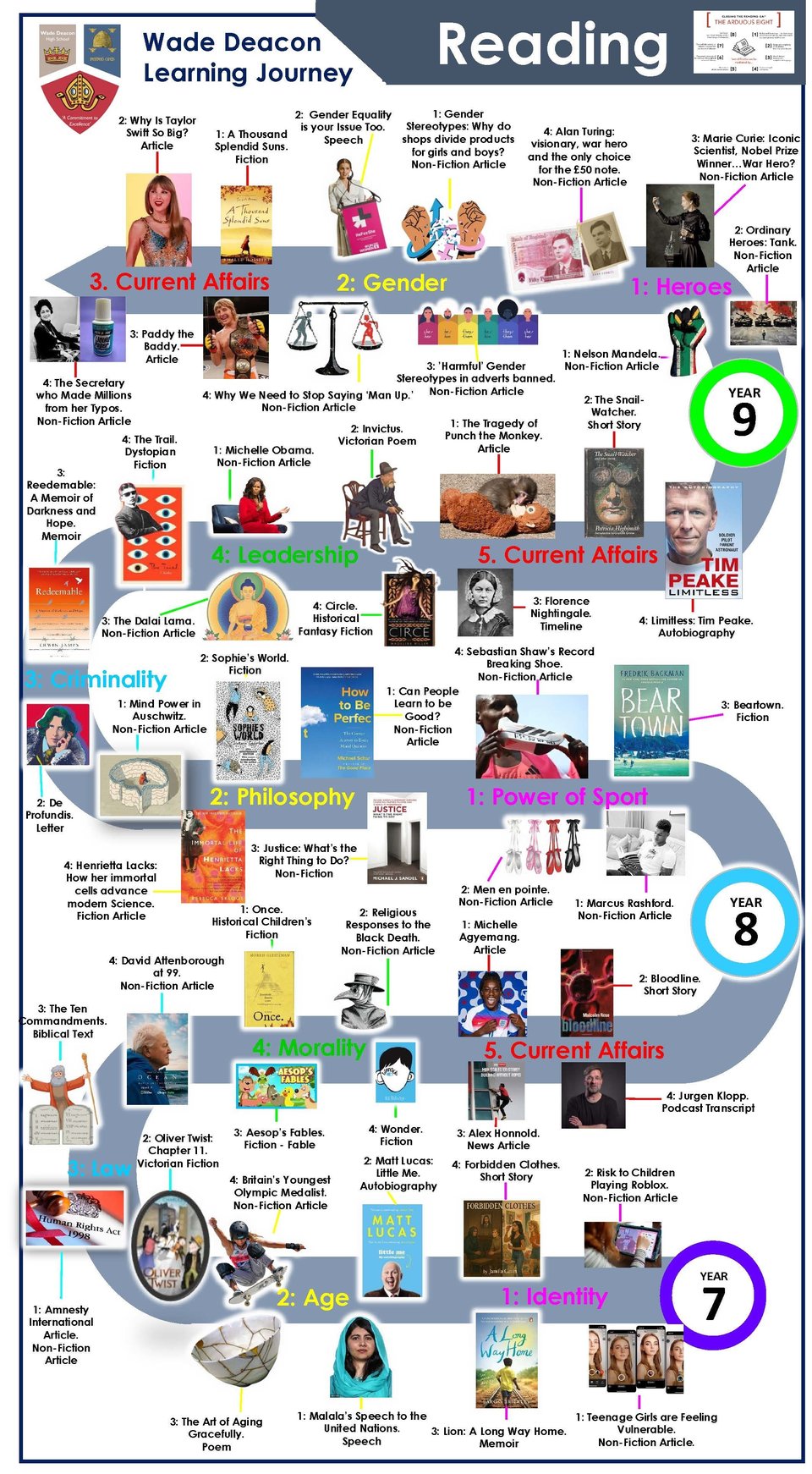
Our Reading Curriculum takes students on a carefully sequenced journey through Years 7, 8 and 9, progressively increasing the complexity of the vocabulary, ideas, structures and texts that students encounter. As students progress, we want them to become increasingly confident, independent and critical readers.
Year 7
In Year 7, students explore Identity, Age, Law, Morality and Current Affairs. These themes introduce students to important questions about themselves, society and the wider world while exposing them to a broad range of fiction and non-fiction texts.
- Identity: explores what shapes identity and how individuals understand themselves and others. Students encounter contemporary issues alongside different cultural experiences through texts including Lion by Saroo Brierley and Forbidden Clothes by Jamelia Gavin.
- Age: considers how experiences and perspectives can change throughout people's lives, as well as the achievements of young people. Texts include Malala Yousafzai's United Nations speech, an extract from Little Me by Matt Lucas and writing about Sky Brown.
- Law: introduces students to ideas surrounding justice, human rights, responsibility and the purpose of laws. Students encounter texts ranging from an extract from Oliver Twist by Charles Dickens to contemporary reporting from Amnesty International and the BBC.
- Morality: encourages students to consider right and wrong, individual choices and the way moral ideas are communicated across different cultures and periods. Texts include Once by Morris Gleitzman, Aesop's fables and Wonder by R J Palacio.
- Current Affairs: connects reading with events, people and issues in the wider world, encouraging students to see reading as a means of staying informed and understanding different experiences and perspectives.
Year 8
In Year 8, students explore The Power of Sport, Philosophy, Criminality, Leadership and Current Affairs. Reading becomes more conceptually demanding, with students encountering increasingly sophisticated vocabulary, structures and ideas and being encouraged to question, discuss and evaluate different perspectives.
- The Power of Sport: considers how sport can influence individuals and society, exploring ideas such as resilience, achievement, identity and stereotypes. Students read texts about Marcus Rashford and marathon runner Sebastian Sawe, alongside an extract from Beartown by Fredrik Backman.
- Philosophy: introduces students to more abstract thinking and some of life's bigger questions, including morality, responsibility, identity and what it means to be good. Texts include Sophie's World by Jostein Gaarder and Justice: What's the Right Thing to Do? by Michael J. Sandel, alongside writing about the scientific and ethical legacy of Henrietta Lacks.
- Criminality: explores crime, justice, punishment, responsibility and redemption through a range of challenging voices and forms. Students encounter writing including De Profundis by Oscar Wilde, Redeemable by Erwin James and The Trial by Franz Kafka.
- Leadership: asks students to consider what makes an effective leader and explores themes including resilience, compassion, influence and responsibility. Texts include an interview with Michelle Obama, Invictus by William Ernest Henley and writing by the Dalai Lama.
- Current Affairs: continues to broaden students' knowledge of the wider world through contemporary and engaging texts, while exposing students to different forms of writing and increasingly challenging vocabulary and syntax.
Year 9
In Year 9, students explore Heroes, Gender and Current Affairs. Students encounter increasingly complex and mature ideas and are expected to read with greater independence, evaluate competing perspectives and navigate sophisticated language and structures in preparation for Key Stage 4.
- Heroes: challenges students to consider what it means to be heroic and whether heroism can take different forms. Through reading about figures including Nelson Mandela, Marie Curie, Alan Turing and Tank Man, students encounter themes of courage, resilience, sacrifice, justice and social change.
- Gender: encourages students to examine stereotypes, equality, representation and the influence of language and society. Students encounter different perspectives through texts including Emma Watson's Gender Equality is Your Issue Too speech and contemporary articles exploring gender stereotypes in advertising and society.
- Current Affairs: provides opportunities for students to engage with complex contemporary and cultural issues through both fiction and non-fiction. Texts include an extract from A Thousand Splendid Suns by Khaled Hosseini, alongside journalism exploring popular culture, achievement, adversity and men's mental health.
The Reciprocal Reading Model
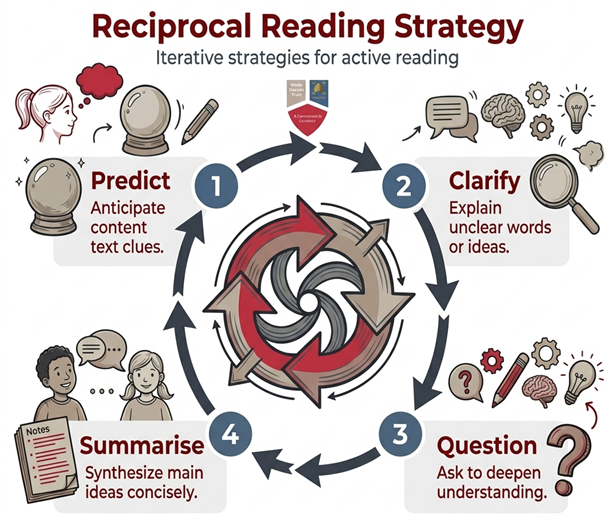
Previewing and Predicting>Reading and Clarifying>Questioning and Discussing>Summarising and Reflecting
These routines enable students to activate prior knowledge, clarify unfamiliar vocabulary, interrogate meaning, discuss interpretations and consolidate understanding. Over time, students develop an increasingly sophisticated toolkit that enables them to approach unfamiliar and challenging texts with confidence.
Above all, our curriculum journey reinforces our belief that Reading is Power: the power to learn, the power to understand, the power to question and the power to succeed.