Teaching, Learning & Assessment
Our Teaching and Learning Model
At Wade Deacon High School, we are committed to creating a culture of excellence through consistently high-quality teaching, learning and assessment. Our Teaching and Learning Model provides a shared approach that enables all students to experience clear routines, high expectations and ambitious learning in every classroom.
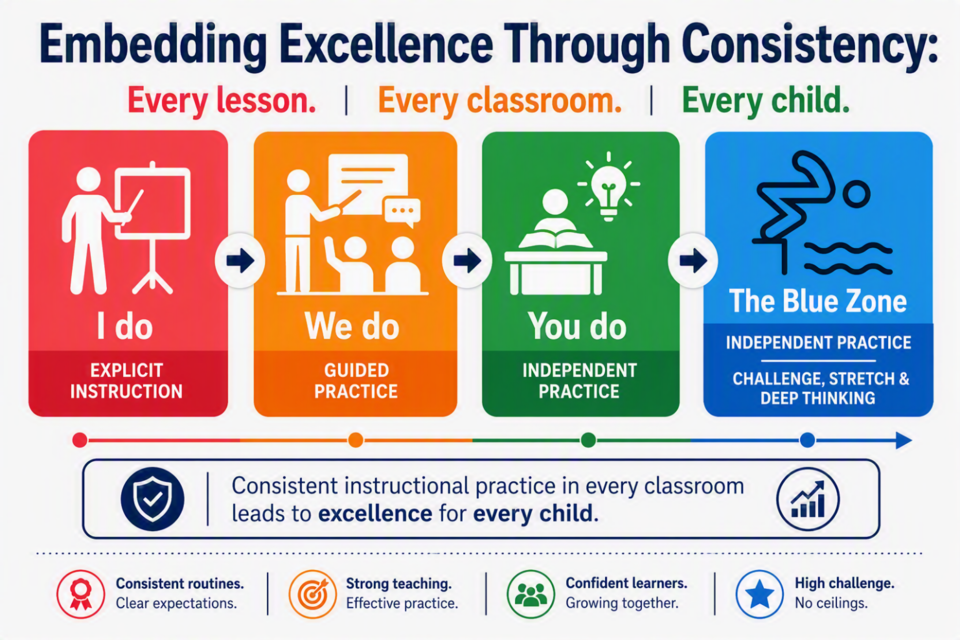
Built around a gradual release model of instruction, lessons follow a carefully structured journey through I Do, We Do, You Do and The Blue Zone, allowing students to develop knowledge, practise new learning with support and apply their understanding independently.
The model is underpinned by purposeful retrieval practice, explicit teaching, guided practice, independent learning and responsive feedback. Through consistent classroom routines and a relentless focus on inclusion, we aim to ensure that every student succeed and achieve their full potential.
Assessment & Feedback:
At Wade Deacon High School, we use our core values to guide our decisions about assessment. We believe that:
- All assessments should be carefully designed to ensure that they support and develop the key knowledge and skills required for success.
- Assessment should be used to inform the teacher about students’ learning as well as to identify gaps in knowledge, skills and understanding.
- Information from Assessments should be used to plan lessons and provide students with feedback on how to accelerate learning.
- Greater emphasis should be placed on formative assessment however, information from such assessments can be used summatively.
- Assessments should incorporate smaller but more regular MAPs (Mini-Assessment Points) to support this ongoing formative feedback. MAPs are NOT tests but a key learning point / low stake quiz where the student is provided with feedback and given an opportunity to accelerate learning.
- Our Assessment model should have consistent principles, to be used across subjects, but the flexibility to be suitable for all subjects.
- Assessment should improve students’ learning - not just measure their learning.
- Providing feedback to students should not be burdensome for staff.
Please click on the links below to listen to an audio presentation of Assessment, Feedback and Reporting Key Stage 3 and Key Stage 4.
Wade Deacon Learning Journey
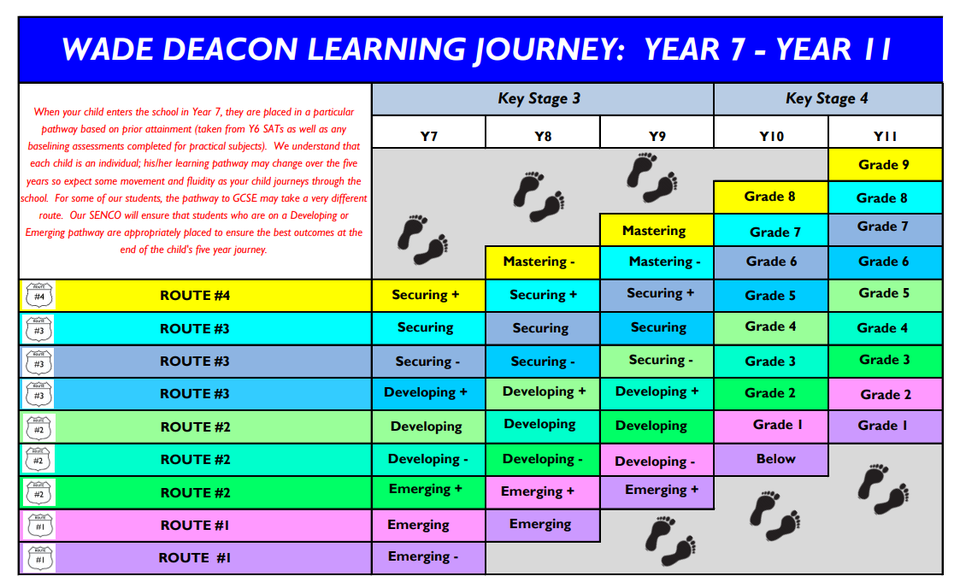
- All students at Wade Deacon High School will take a particular learning journey that is individual to them and their individual needs.
- When a child enters the school in Year 7, they are placed in a particular pathway based on prior attainment (taken from Y6 SATs as well as any baseline assessments that are completed).
- The learning journey that each child takes may change over the five years; some movement and fluidity is expected as each child journeys through the school. For some of our students, the pathway to GCSE may take a very different route if this is appropriate for the child.
- There are four available pathways for students: Route 1 – Route 4.Over the five years at Wade Deacon, students will move through this pathway to Key Stage 4.Each Route is assigned Descriptors to describe students’ academic ability: Emerging, Developing, Securing, Mastering or Excelling. In each subject, students are given end of year targets based on these Descriptors. The Target also includes a + or – to show whether students sit at the top or the lower end of the Threshold.
- In Years 10 and 11, students will be given a numerical Target Grade for GCSE.
Feedback (Y7 – Y9):
- Students in Y7-Y9 complete MAPs; MAPs are not tests and should not be treated as such. The frequency of MAPs is determined by curriculum time and specified for each subject area.
- Each student is provided with feedback (😊 & Target) and the opportunity to Accelerate and demonstrate progress.
- Following each MAP, teaching is responsive: planning and feedback will focus on students moving from one threshold to another.
- All other work in books / in class is building up to these MAPs and will not be provided with written feedback from the class teacher. Instead, planning focuses on the methodology, skills and content required as well as providing feedback in the lesson.
- At three scheduled points throughout the academic year, parents are informed about their child’s progress. In the first reporting cycle (P2S1), students receive an Attitude to Learning grade. In the second and third reporting cycles (P2S2 and P2S3), teachers provide an attainment descriptor together with a progress comment, informed by assessment performance.
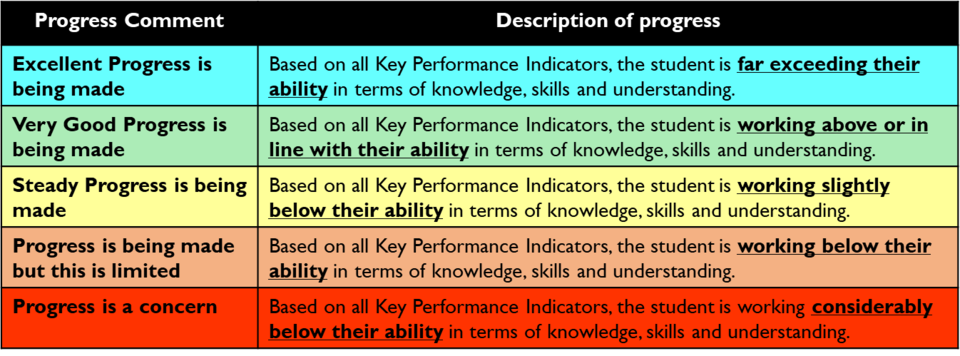
- The class teacher will be able to choose from one of the 5 progress comments (shown below).To make this evaluation, class teachers will look at students’ work to see how this compares to their targets and their potential.
Feedback Y10-Y11
- Students in Y10-Y11 will also complete MAPs however, these might be bigger assessments linked to the GCSE papers. Throughout Key Stage 4, students will be given more opportunities to complete full GCSE papers. This is to build up students’ stamina in preparation for the GCSE examinations.
- Following each MAP, teaching is responsive: planning and feedback should focus on students moving from one threshold to another.
- All other work in books/in class is building up to these MAPs and will not be provided with written feedback from the class teacher. Instead, planning focuses on the methodology, skills and content required as well as providing feedback in the lesson.
- At three scheduled points during the academic year, parents receive information about their child’s progress. During the first reporting cycle (P2S1), Y10 students receive an Attitude to Learning grade. During the second and third reporting cycles (P2S2 and P2S3), teachers provide an attainment grade and a progress comment based on assessment outcomes and class performance. For Year 11 students, all three reporting cycles include attainment and progress information to support preparation for external examinations.
- A student’s Target Grade in Y10 will be one grade below the expected GCSE grade for the end of Y11.
- The class teacher will be able to choose from the 5 progress comments (indicated above) based on the expected GCSE flight path for each subject.
- It is important to remember that completing a section of an exam paper is not the same as completing the paper in its entirety; whilst students may have performed well on a smaller element, the grade reported has to consider these pieces in relation to the whole GCSE.
- In Y10, the grade reported will likely be a distance away from the Target – this is to be expected, especially at the start of the GCSE course where there is still content, knowledge and skills to be covered.